If you are serving or sampling food at a trade show or any other event, the organiser will almost always ask for a food safety plan based on HACCP. It needs to cover what you will do at this event, on this stand, not what happens in your factory or kitchen. This guide explains what to put in it and how to keep it short.
Why a plan for the stand
Food law requires every food business to put in place, and follow, a food safety procedure based on the HACCP principles (Regulation 852/2004, Article 5). The Food Standards Agency puts it simply: if you run a food business, you must make and follow a system for managing food safety (FSA food hygiene guidance).
At an event the risks are different from your normal operation. Food travels further, it sits on a stand for long hours, fridges are smaller, water is limited and the people serving may be temporary staff. That is why organisers ask you for a plan written for the event, even if your business has BRC or SALSA certification. The AEV eGuide, the standard most UK venues work to, says the HACCP principles must be followed and that you carry out and document a food safety risk assessment (HACCP plan) covering each activity on your stand (what the eGuide expects).
What to put in it
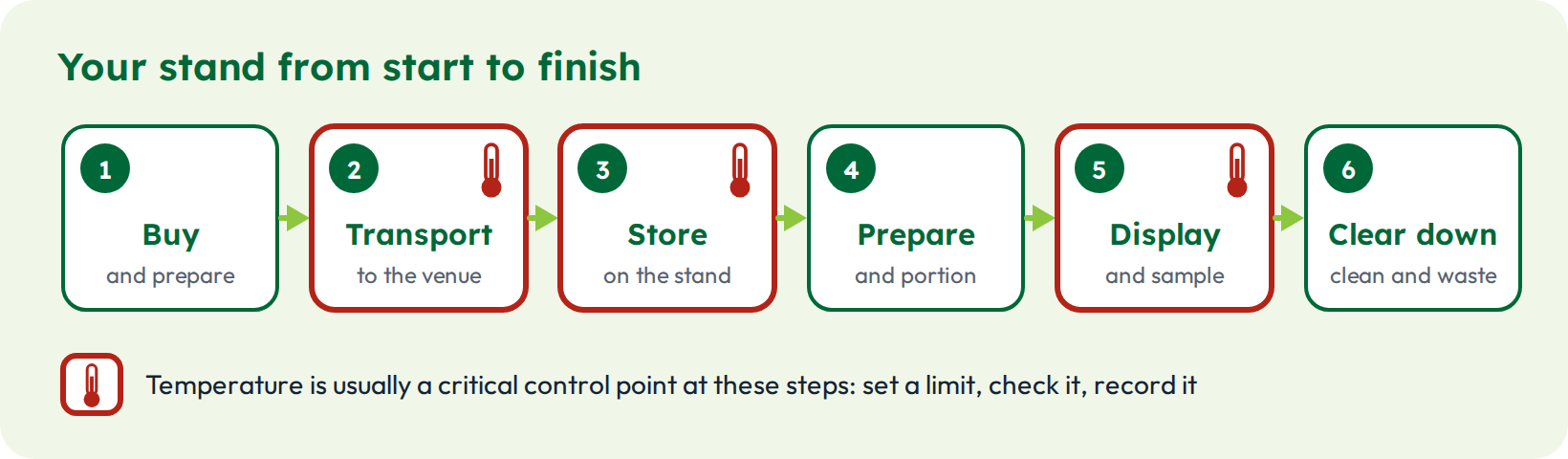
Keep the plan in proportion to what you are doing. A stand offering wrapped chocolates needs a page; a stand cooking chicken needs more. We recommend a simple table with one row per step:
| Step | Hazard | Control and limit | Check and record |
|---|---|---|---|
| Buying and preparing at base | Bacteria growing, allergens missed | Approved suppliers, use-by dates, allergen specs for every ingredient | Delivery checks, allergen matrix |
| Transport to the venue | Chilled food warming up | Cool boxes or a chilled van, food at 8°C or below | Probe on arrival, write it down |
| Storage on the stand | Chilled food warming up, contamination | Fridge set to 5°C or below, food covered and off the floor | Fridge reading at opening and through the day |
| Preparing and portioning | Cross-contamination, dirty hands | Hand-wash basin, clean utensils, raw and ready-to-eat kept apart | Cleaning checklist |
| Display and sampling | Time out of the fridge, visitor contamination | Covered display, single portions, 4-hour limit for chilled food out of the fridge | Time labels on each batch |
| Clearing down | Waste attracting pests, dirty equipment | Closed bins, food waste removed daily, equipment washed | Closing checks |
If you cook or hot hold, add rows for cooking (core temperature, for example 75°C for 30 seconds) and hot holding (63°C or above). Our temperature control guide has the figures.
The seven principles in plain terms
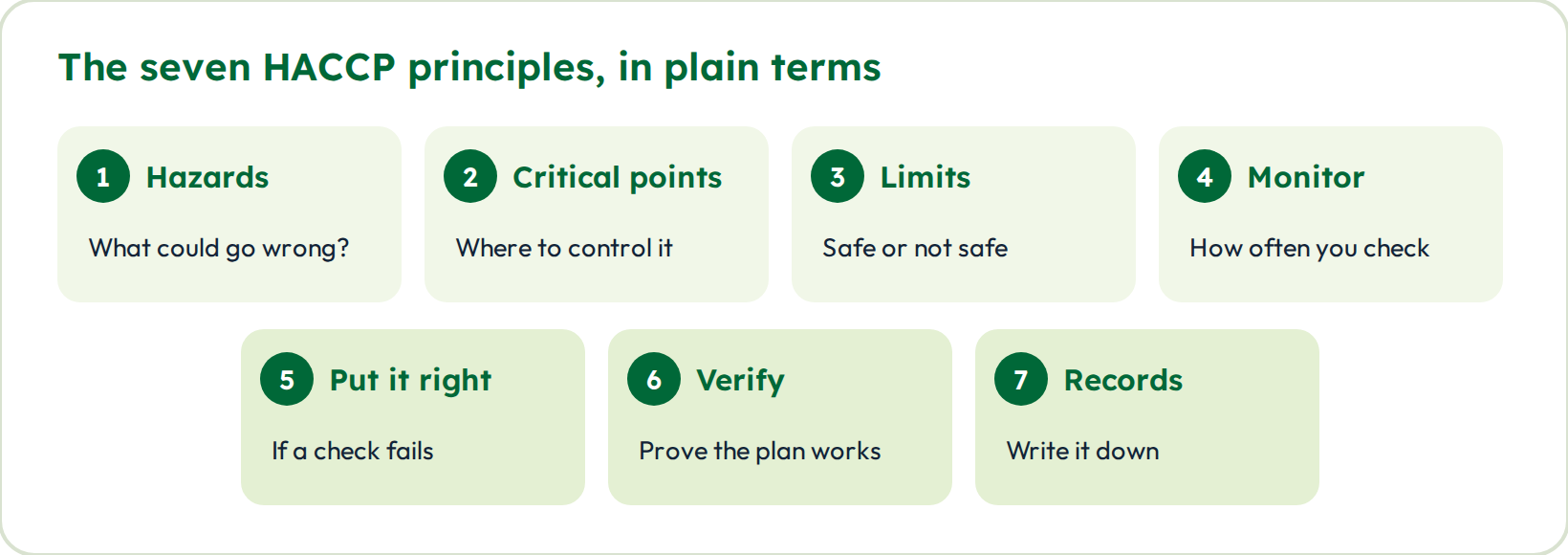
The law lists seven principles. On a stand they come down to a few practical questions:
- Hazards. What could make someone ill? Bacteria growing in food left warm, cross-contamination from hands or utensils, allergens, foreign bodies such as cocktail sticks or broken glass.
- Critical control points. The steps where control is essential, usually chilled storage, cooking and hot holding.
- Critical limits. The figure that separates safe from unsafe, for example 8°C for chilled food or 63°C for hot holding.
- Monitoring. Who checks, how and how often. “Probe the fridge at opening, midday and close” is better than “temperatures are monitored”.
- Corrective action. What you do when a check fails: move food to another fridge, reheat once, or throw it away.
- Verification. How you know the plan works, for example a probe that has been checked for accuracy and a manager who reviews the records each day.
- Records. Proportionate to the size of the business: a temperature log, cleaning checklist and allergen matrix are usually enough for a stand.
Things that make a plan easy to accept
- It names the event products. If you are serving three cheeses and a chutney, list them.
- It matches the stand. If the plan says there is a hand-wash basin and fridge, there should be one on the stand.
- It says what happens if something goes wrong, including a food poisoning or allergic reaction complaint.
- It is on the stand during the show, on paper or a device, and the staff serving know what is in it.
- It has been reviewed for this event. A plan from a different show with the wrong products is one of the most common gaps we see.
If you are a small business without a plan, the FSA’s free Safer food, better business pack is a good starting point. Use its safe methods and add a page for the event steps above. For more on how a full system fits together, read what a food safety management system is.