Most large UK exhibition venues work to a shared set of standards called the eGuide. It is published by the Association of Event Venues (AEV) and revised every August. Organisers usually build its catering rules into their exhibitor terms, so if you are serving or sampling food it is worth knowing what it says. This guide covers the August 2026 edition.
What the eGuide is
The eGuide brings together guidance on health, safety and operations for events at participating AEV member venues. The AEV describes its status as like that of an Approved Code of Practice. Its Catering section (section 10) covers hospitality catering, selling food, sampling, alcohol, and planning and running a food stand.
The eGuide places responsibility for food safety and allergen compliance at an event on the organiser, and says organisers must appoint a food safety consultant where there is a significant level of risk on stands producing food for sampling. That is often where we come in: we review your documents before the show and visit your stand on the day, then the organiser decides. See Event Safety.
Before the event: 28 days
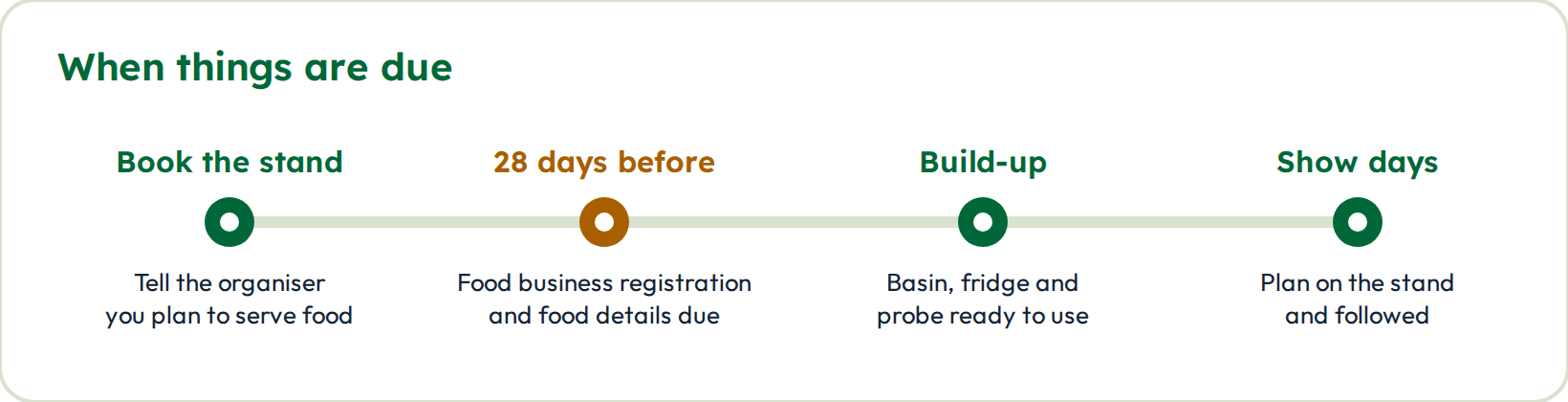
- Tell the organiser what you plan to serve. Full details of preparation, cooking and serving arrangements go to the venue no later than 28 days before tenancy (paragraph 3). Sampling must be notified in writing (paragraph 24).
- Register as a food business. Anyone carrying out a food operation, including sampling, needs to be registered with their local authority, or show they are exempt, no later than 28 days before the event (paragraphs 11 and 12). If you are an international exhibitor at a trade event, you may not need to register; the food safety consultant can check this with the local authority for you (paragraph 13).
- Selling food. Any sale needs the venue’s approval. Food and drink sold from stands should be in its original sealed packaging and for off-site consumption (paragraphs 22 and 23).
Sampling rules
You can offer samples of an edible product you are promoting as long as you tell the organiser in writing, the samples are free and the product is a core part of your business (paragraph 24).
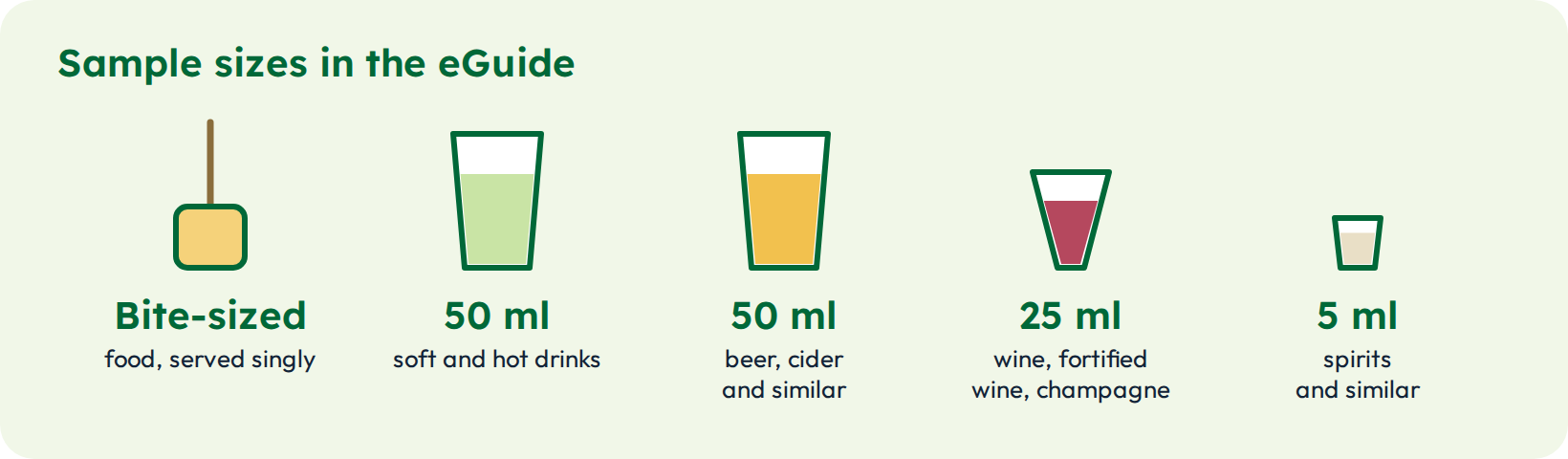
- Food: singly served, bite-sized portions, or individually wrapped items for off-site consumption (paragraph 25). Larger samples need the venue’s agreement and a fee may apply (paragraph 26).
- Drinks: 50 ml for soft and hot drinks, 50 ml for beer and cider, 25 ml for wine, fortified wine and champagne, 5 ml for spirits. In Scotland, only one sample of any alcoholic drink per person (paragraph 28).
- Hot drink samples in double-walled cups and drunk on the stand, or with close-fitting lids (paragraph 29).
- Your risk assessment should cover how samples are offered: never from knife blades, no double-dipping, no fingers in the food, cutlery used once, crockery cleaned before refilling, and a place for used sticks and stones (paragraph 27). Our sampling guide turns this into a stand layout.
Washing facilities: the paragraph 57 chart
Paragraph 57 is a chart that sets the washing facilities by the risk of what you serve. You are responsible for assessing your operation and providing suitable washing facilities (paragraph 51).
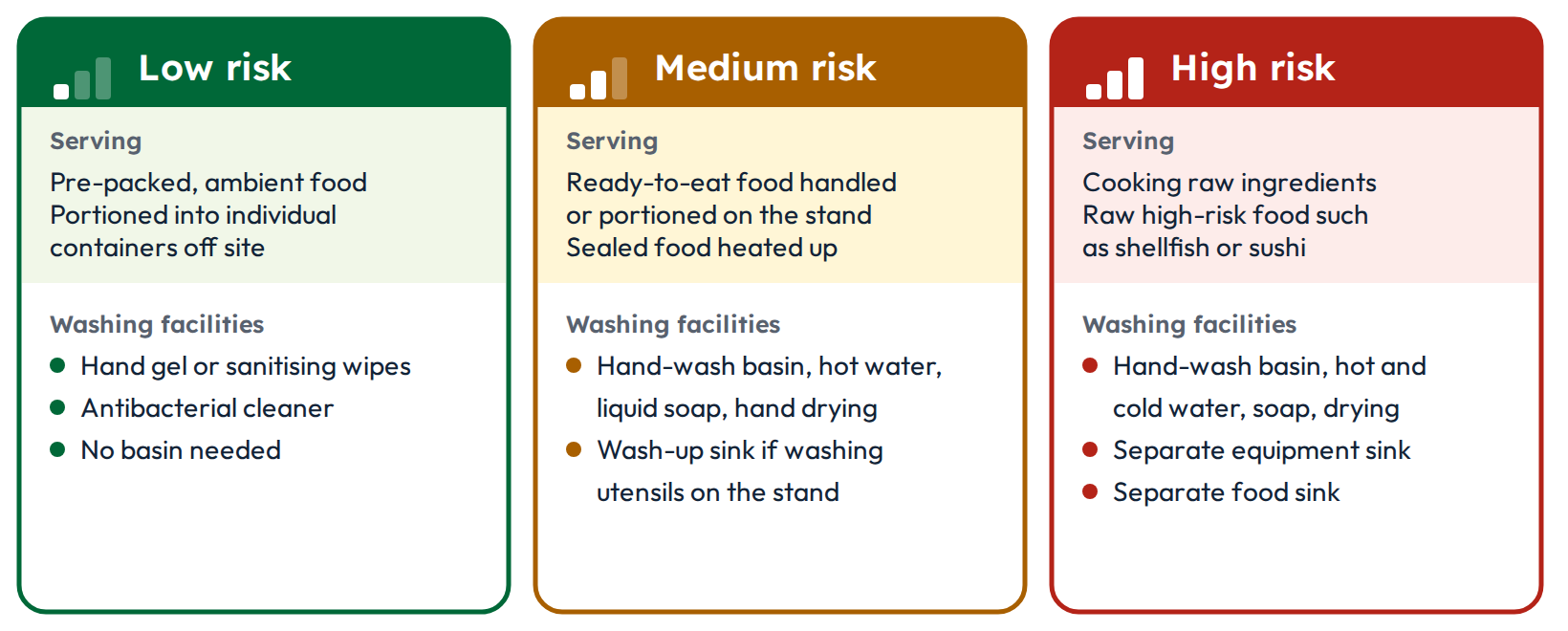
| Category | What you serve | Washing facilities |
|---|---|---|
| Low risk | Pre-packed, ambient foods such as crisps, drinks, chocolate, snack bars and single-serving cakes; or products portioned into individual containers off site and not handled on site. | No washing facilities required. Sanitising hand wipes or antibacterial hand gel, and antibacterial cleaner or sanitiser. |
| Medium risk | Pre-prepared, sealed foods that need heating, such as sauces, soups and tinned ingredients; or ready-to-eat food handled or portioned on the stand, such as ice cream, cheese, ham and other cooked meats. | Hand-wash basin with hot water, liquid soap and hand drying, set up before any food preparation begins. Disposable utensils, or enough to wash off site each day, or a dedicated wash-up sink. Antibacterial cleaner or sanitiser. |
| High risk | Cooking with raw ingredients or changing food with temperature, such as rice, fish, eggs, meat (including burgers and sausages), poultry, plant-based foods, pulses and grains; or preparing or serving high-risk raw foods such as shellfish and sushi. | Hand-wash basin with hot and cold water, liquid soap and hand drying, set up before any food preparation begins. A separate sink for equipment washing and a separate sink for food washing. Antibacterial cleaner or sanitiser. |
A basin used for hand washing must be used for nothing else and be easy to reach at all times (paragraph 54). Where a shared hand-wash facility is agreed, it must be no more than 3 metres from any preparation area; in Scotland, hand-washing facilities must be within the preparation area (paragraph 55). More detail in hand washing and wash hand basins on stands.
HACCP plan and allergens
The eGuide says the HACCP principles must be followed and that you document a food safety risk assessment (HACCP plan) covering each activity on your stand, including any alcohol (paragraph 34). It also asks for an allergen management plan with accurate information on the 14 allergens, signs telling visitors the information is available, separation of allergen foods and a procedure for allergic reactions (paragraph 39). See writing a food safety plan for your stand and allergen information on your stand.
Temperatures, hygiene and training
- Hot food held at 63°C or above, or below 63°C for one period of up to two hours, then thrown away, chilled to 8°C or below, or reheated and held again (paragraph 65; in Scotland, reheat to 82°C).
- Cold food out of temperature control for one period of up to four hours, then thrown away (paragraph 65). Its temperature guide marks 5°C for fridges and 8°C for food storage. See temperature control.
- Anyone on your stand handling open food should wash their hands regularly, cover cuts with a blue waterproof dressing, wear an apron, avoid jewellery that could contaminate food and not handle open food within 48 hours of stomach illness symptoms (paragraph 70).
- Training: everyone handling food on your stand trained to match their duties and supervised, with evidence of training available on site (paragraph 66). See food hygiene training for stand staff.
- Waste: food waste kept apart from other waste in closed containers and not left on site; no liquids poured into toilets, basins or floor ducts (paragraphs 60 and 61).
- Complaints: you investigate any food poisoning or allergic reaction allegation under your HACCP plan, as the food provider, and tell the venue straight away (paragraph 71).