Temperature control is usually the most important part of your food safety plan. Fridges on stands are small and opened constantly, stands get warm, and food is often on display for hours. This guide sets out the figures from food law and the FSA, the time rules for food on display, and how to check and record with a probe thermometer.
The figures
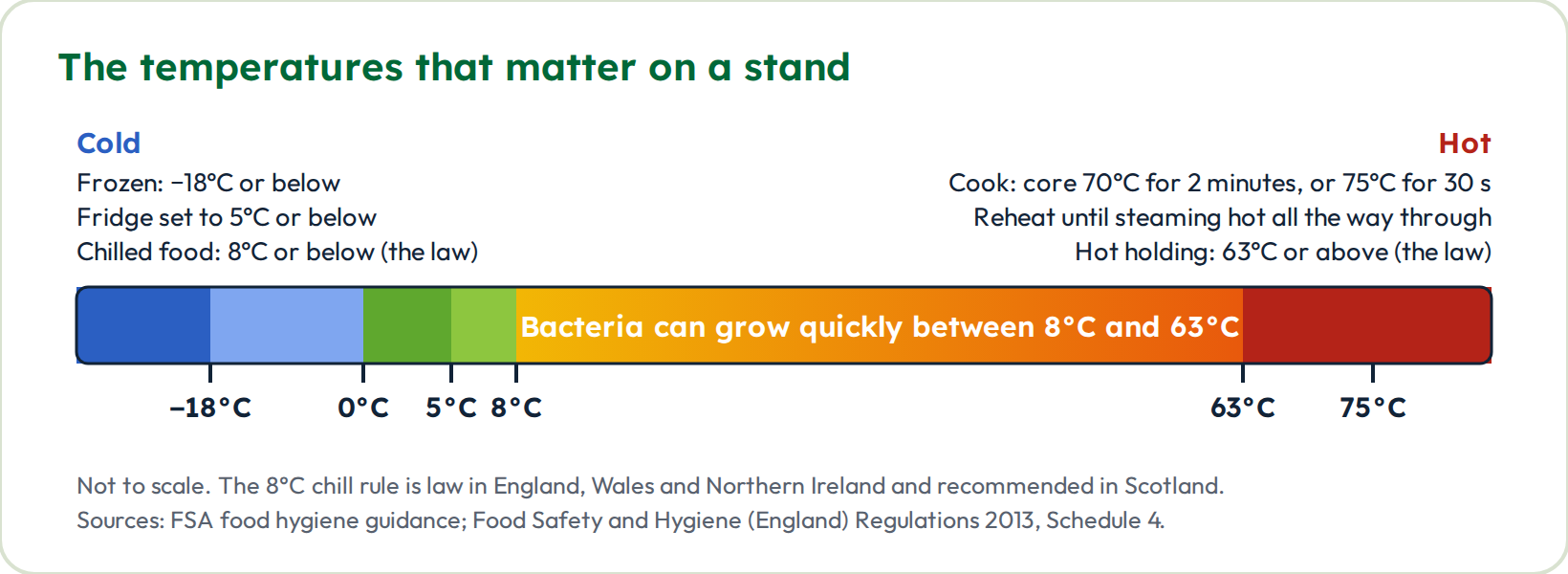
| What | Temperature | Where it comes from |
|---|---|---|
| Chilled food | 8°C or below | The law in England, Wales and Northern Ireland; recommended in Scotland |
| Fridge setting | 5°C or below | FSA advice, so food stays below 8°C when the door is opened |
| Frozen food | −18°C or below | FSA Safer food, better business |
| Cooking | Core 70°C for 2 minutes, or another safe combination such as 75°C for 30 seconds | FSA standard advice |
| Reheating | Steaming hot all the way through, once only | FSA; in Scotland, at least 82°C |
| Hot holding | 63°C or above | Food law in England, and FSA guidance |
In England the chill and hot-holding rules are in Schedule 4 of the Food Safety and Hygiene (England) Regulations 2013. The FSA’s food hygiene guidance sets out the same figures in plain English.
Food on display: one period only
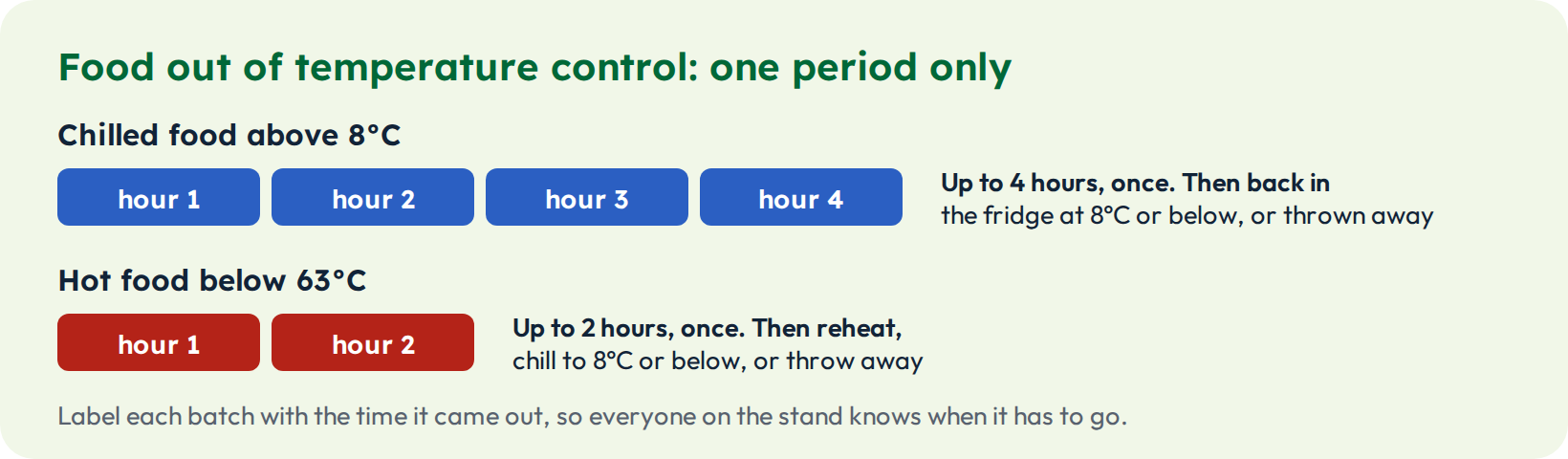
- Chilled food can be out of the fridge for one period of up to 4 hours while it is on display. If it has been out for less than 4 hours it can go back in the fridge; after 4 hours it should be thrown away.
- Hot food can be kept below 63°C for one period of up to 2 hours. After that, reheat it once until steaming hot and put it back in hot holding, chill it quickly to 8°C or below, or throw it away.
- Only put out what you need, label each batch with the time it came out, and do not top up old food with new.
For most sampling stands the simplest approach is to keep stock in the fridge and bring out small amounts often. That keeps samples fresh and well inside the 4-hour limit.
Chilled storage on the stand
- Bring enough fridge space for the busiest day, or arrange daily deliveries. A fridge packed tight does not hold temperature.
- Pre-cool fridges and chilled display units before loading them.
- Keep chilled food at 8°C or below on the way to the venue, in a chilled van or cool boxes with enough ice packs. Probe it when it arrives and write the reading down.
- Check the fridge at least once a day, starting at opening. We recommend checking several times a day at a show, because doors are opened so often.
- Do not rely only on the fridge’s own display: check it against a fridge thermometer or by probing between packs.
Probe checks
If you serve chilled or hot food, a digital probe thermometer is the one piece of kit your stand should have. Use it to check deliveries, fridges, cooking, reheating and hot holding, and to prove your plan works.
- Clean and disinfect the probe before and after every use. Probe wipes are the easiest way; make sure they have not dried out.
- Insert the tip into the centre or thickest part of the food. For chilled storage you can probe between two packs.
- Wait for the reading to settle, then write it down with the time and your initials.
- If a reading is outside your limit, follow the corrective action in your plan and note what you did.
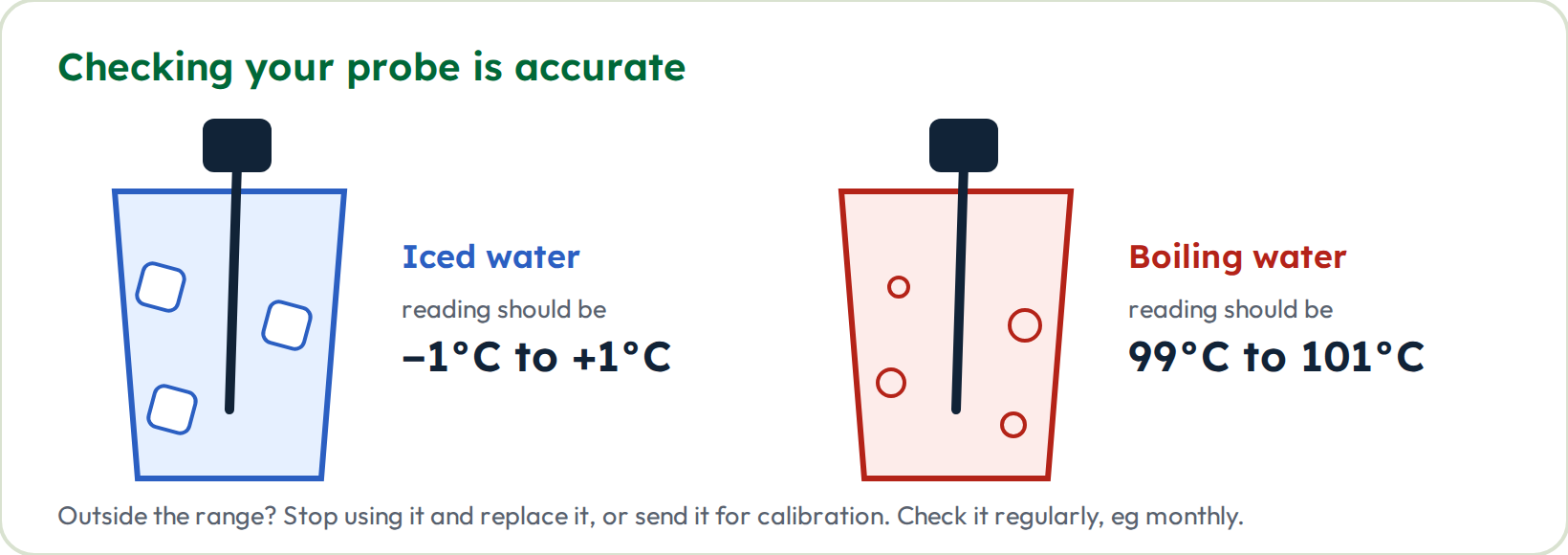
Check the probe is accurate regularly, for example monthly or as the maker says. In iced water it should read between −1°C and 1°C, and in boiling water between 99°C and 101°C. If it is outside that range, replace it or send it back for calibration (FSA SFBB, Prove it). Some organisers ask for a recent calibration date, so a probe with a calibration certificate saves a question.
Thermometers we sell
We sell ETI thermometers that suit stands. A few that fit the checks above:
- Thermapen One: fast probe thermometer, supplied with a traceable calibration certificate.
- FoodCheck thermometer and probe: a hard-wearing everyday probe, also with a calibration certificate.
- ThermaLite food probe: pocket-sized and waterproof.
- Fridge and freezer alarm thermometer: shows the fridge temperature without opening the door and alarms if it drifts.
- Antibacterial probe wipes or single sachet wipes for cleaning the probe between checks.
- UKAS 3-point calibration for an existing instrument and probe.
See the full range of food thermometers.