

Is a food hygiene certificate a legal requirement in the UK? No. Neither you nor your staff have to hold one. What the law does require is that every food business makes sure its food handlers are supervised and instructed or trained for the work they do, and that you can prove it. A certificate isn’t the only way to show that, but it is by far the easiest, and it’s what inspectors, organisers and venues usually ask to see.
Is a food hygiene certificate a legal requirement?
No. GOV.UK is very clear on this. Its staff training guidance says “food handlers do not have to hold a food hygiene certificate” (GOV.UK, staff training, illness and hygiene). The Food Standards Agency’s guidance for new businesses says the same, that it is not compulsory to have a certificate, while recommending a food hygiene qualification if you are starting out (GOV.UK, starting a food business).
What the law does ask for is training. The rule sits in Regulation (EC) No 852/2004, retained EU food law that still applies across the UK. Annex II, Chapter XII says food business operators must ensure “that food handlers are supervised and instructed and/or trained in food hygiene matters commensurate with their work activity” (legislation.gov.uk, Regulation 852/2004 Annex II Chapter XII).
That duty has teeth. In England, the Food Safety and Hygiene (England) Regulations 2013 make it an offence to break the hygiene requirements of Regulation 852/2004, including the general requirements in Annex II. Scotland, Wales and Northern Ireland do the same through the Food Hygiene (Scotland) Regulations 2006, the Food Hygiene (Wales) Regulations 2006 and the Food Hygiene Regulations (Northern Ireland) 2006. So the certificate is optional, but the training isn’t.
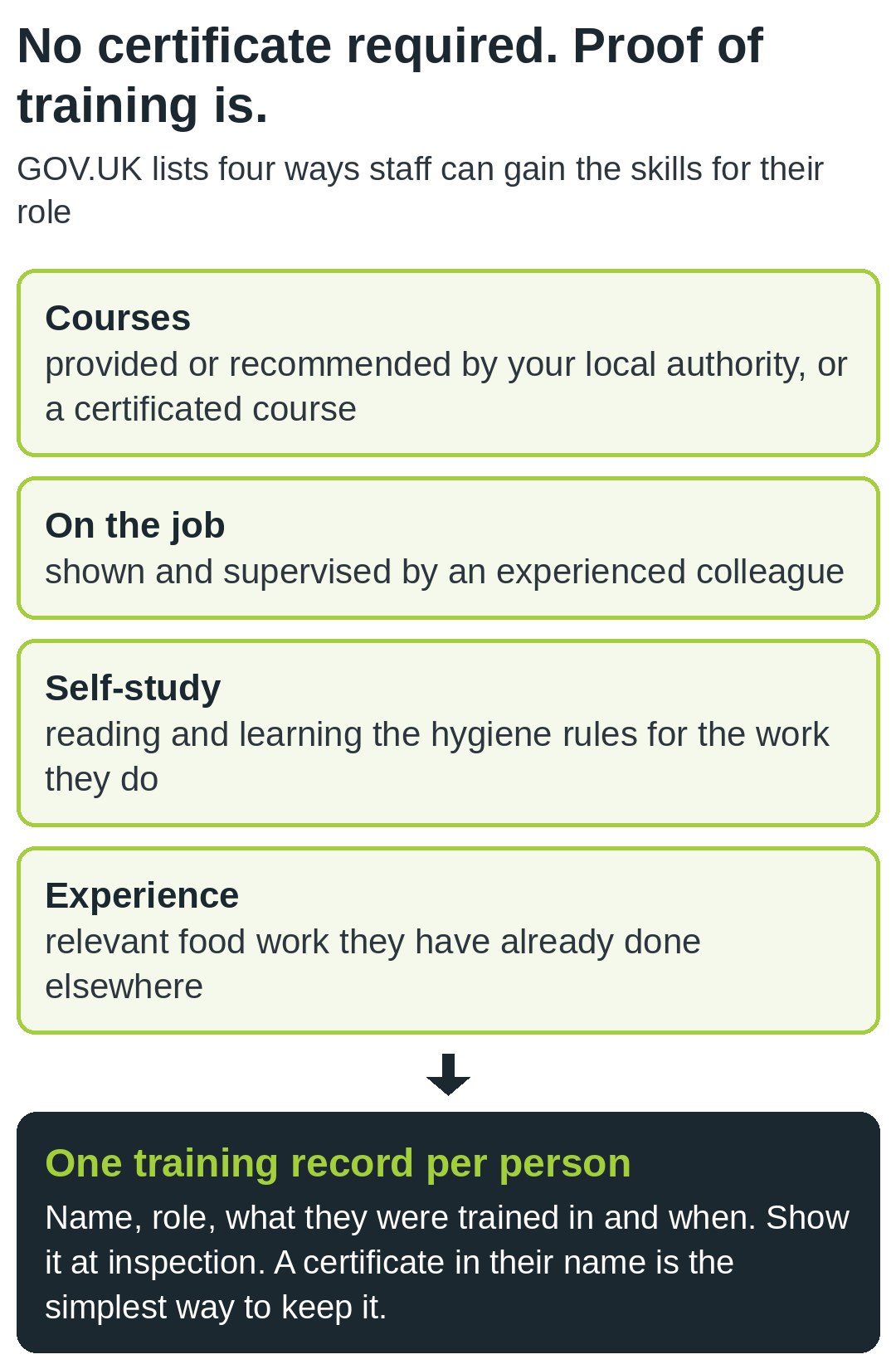
What food safety law asks of every food business
It asks for four things, and none of them name a course or a certificate. Here is what each one means in practice for an employer.
- Training that fits the job. Food handlers must be supervised and instructed or trained in line with their work activity. A kitchen porter washing pots and a chef cooling rice for tomorrow both need it, just not the same lessons.
- HACCP training for whoever runs your food safety management. The same chapter says the people who develop and maintain your food safety management procedures, based on HACCP (hazard analysis and critical control point), must have adequate training in applying the HACCP principles. That is the person who runs your food safety management system and decides how each hazard is controlled.
- Allergen training. GOV.UK says staff must be trained to manage allergies, and that all staff should be taught what is appropriate to their role (GOV.UK, allergies).
- Proof. You must be able to show your staff have the right skills and up-to-date training for their role, and GOV.UK tells you to keep a record of any training staff have completed so you can show it during an inspection.
GOV.UK also lists how those skills can be learned. Courses provided or recommended by your local council, training on the job, self-study and relevant previous experience all count. For personal hygiene, it points you to the Safer Food, Better Business pack to build your plan. Whichever route you use, the record is what protects you when an environmental health officer asks.
Do all food handlers need a food hygiene certificate?
No, not every food handler needs a certificate, but every one of them needs suitable training and supervision. A new starter who is shown how to probe hot food by an experienced supervisor, watched until they get it right and has that written down in your training record, has been trained. It just takes more effort to prove than a certificate in their name.
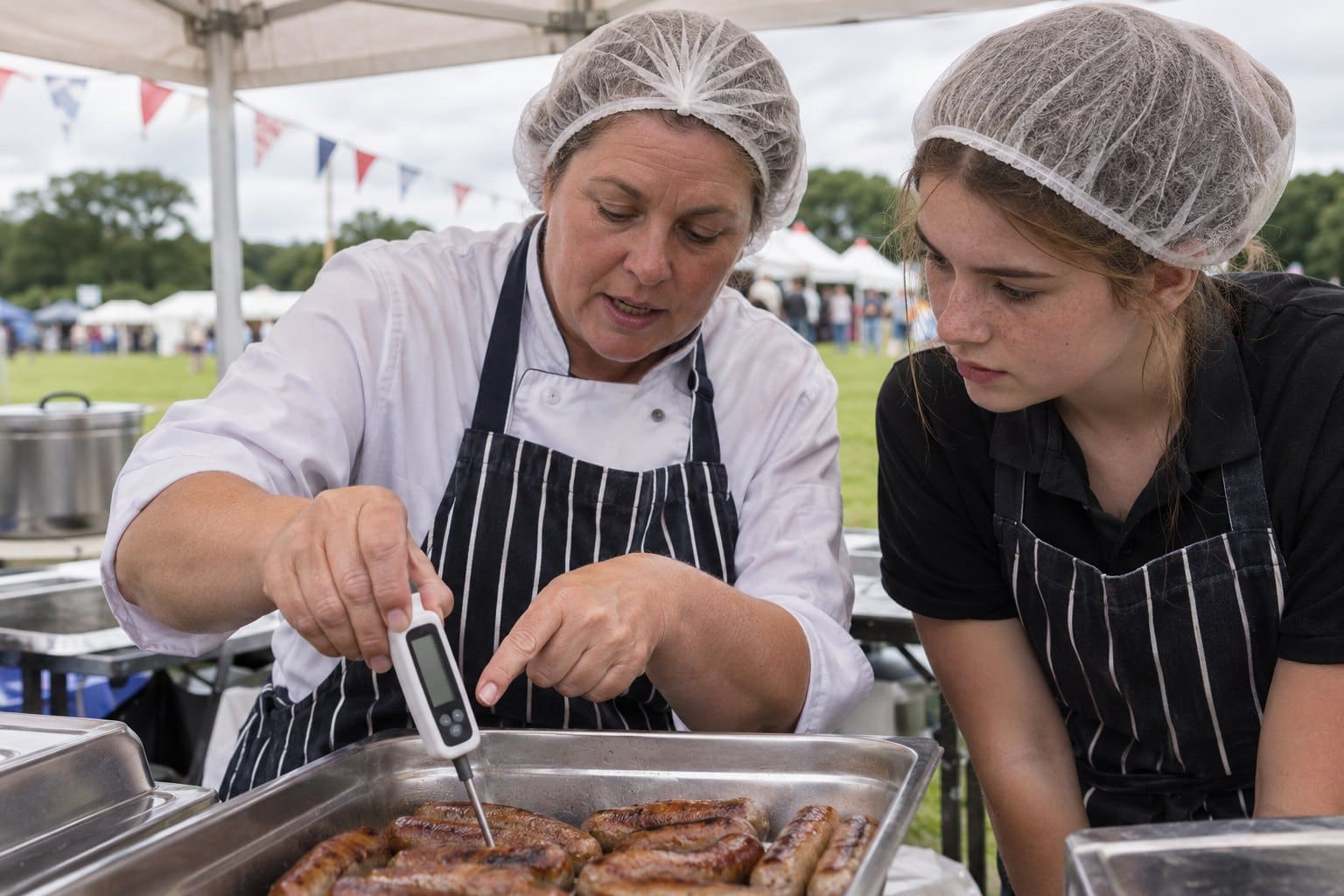
On-the-job training works well for the practical side of good hygiene practice, such as handwashing, cooking and probing, and cleaning down. Where it falls short is consistency. Two supervisors rarely teach the same thing in the same way, and if the person who trained someone leaves, the evidence often goes with them. That’s why it makes sense to put your team through a certificated course as well, then add the job-specific bits on site.
Why a certificate still helps at inspection
A certificated course gives you the skills and the proof in one go, and that matters at every food safety inspection. It also helps in two other places.
At inspection. Under the Food Hygiene Rating Scheme, the third thing an officer looks at is how you manage food safety, including your processes and training. To get the top rating of 5 you have to do well on all three areas (FSA food hygiene rating guidance). A folder of pass dates in each person’s name answers that question in seconds.
At events and shows. If your team serves or samples food at a trade show, exhibition, festival or country show, organisers often ask for proof of training for everyone working on the stand. Having proof ready to show on a phone saves a lot of back and forth before build day. Our guide to allergen training for catering and events covers the allergen side of the same checks.
When supervisors move on. A certificate shows exactly what each person covered and when, so you aren’t relying on the memory of someone who has since left.

Which training course fits each role, from kitchen to supervisor
Match the level to what each person actually does, from handling food in the kitchen to serving it on a stand. The law sets the standard as instruction that fits the work, so the table below starts from the job.
| Role | What the law asks | Training that fits |
|---|---|---|
| Staff who only handle wrapped food (some front of house or stock room jobs) | Instruction or training suited to handling wrapped food | Level 1, or recorded on-the-job training |
| Anyone who prepares, cooks, serves, sells or samples open food, including event stand staff | Supervision and instruction or training suited to handling open food | Level 2 for catering |
| Supervisors, managers, head chefs and whoever runs the food safety plan | Adequate training in applying the HACCP principles, on top of food hygiene | Level 3 for catering, which adds HACCP |
| Every member of staff serving customers | Training to manage allergies appropriate to their role | Allergen content in the course, plus your own allergen procedure |
For most teams, that means Level 2 for everyone who touches open food and Level 3 for the person in charge. If you aren’t sure whether a supervisor needs the higher level, our guide on who needs a Level 3 food safety in catering course goes through it role by role, and our Level 3 Food Hygiene and Safety for Catering course covers HACCP and the supervisor’s job.
Training a team online without losing shifts
The easiest way to train a whole team is online, so nobody loses a shift to a classroom day with another provider. That’s what our level 2 food hygiene certificate is built around.
- 10 short video units with a quiz after each one, about 3 hours in total, with no time limit and progress saved each time someone stops.
- A final online assessment with an 80% pass mark and unlimited retakes at no extra cost.
- A certificate in each person’s name, ready to download the moment they pass, showing the pass date and a recommended renewal date.
- Endorsed by the Institute of Hospitality, matched to the CIEH and RSPH syllabus, designed and presented by a Chartered Environmental Health Officer and accepted by local authorities.
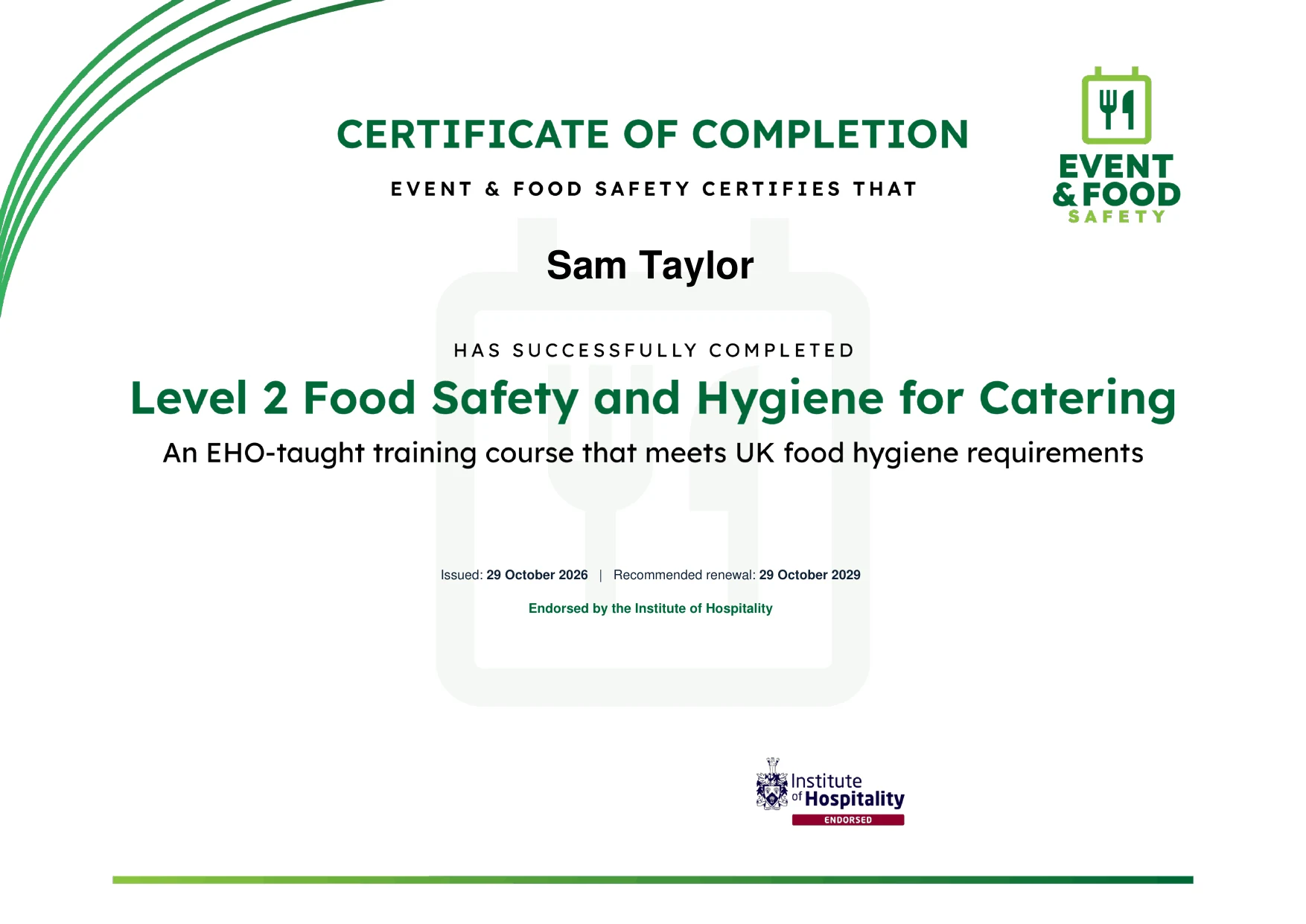
You buy every place in one order and the price per person drops as you add places. Straight after paying you add each person’s name and email, they get their own login, and you can see who has finished and download every certificate in one place from My team. That download is your training record, sorted.
If you want to compare other food hygiene courses, such as classroom options or local council sessions, our guide on how to get a food hygiene certificate in the UK compares them.
Frequently asked questions
Is food hygiene training a legal requirement?
Yes. Regulation 852/2004 requires food business operators to make sure food handlers are supervised and instructed or trained in hygiene in line with their work. That is the duty. A certificate is just the most common way of proving it happened and what it covered.
Do I need a food hygiene certificate to sell food?
No, there’s no legal requirement to hold one to sell food. You do need suitable instruction for what you do, and in England, Wales and Northern Ireland you must register your food business with your local council at least 28 days before trading (GOV.UK registration). If you sell at events, organisers will usually ask for proof of training too.
Do food hygiene certificates expire in the UK?
The law doesn’t set an expiry date, because it doesn’t require a certificate in the first place. What it does need is up-to-date skills for each role, so it makes sense to refresh them on a regular cycle and again whenever someone moves into a role with more food handling. Our certificates show a recommended renewal date to plan around.
What certificate is mandatory if preparing or selling food in the UK?
None is mandatory by law. For staff preparing or serving open food, a Level 2 food hygiene certificate is the usual choice because it covers what inspectors expect and gives you the record. Supervisors and whoever runs your HACCP-based plan usually take Level 3.
Buy places for your team
If you need your team trained and the proof sorted before your next inspection or event, the simplest step is to buy places for your team on our Level 2 course. Each person gets their own login straight away, and their certificate is ready the moment they pass.