Food law requires you to give allergen information for the food you provide, and that includes free samples. On a busy stand it is easy for a cracker, a dip or a garnish to be missed. This guide explains what the law asks for and how to set it up so anyone serving can answer a visitor’s question.
The 14 allergens
You need to tell visitors if any food you provide contains any of the 14 allergens named in food law, including when they are in additives or processing aids (FSA allergen guidance). Visitors may be allergic to other things too, so be ready to answer questions about full ingredients.
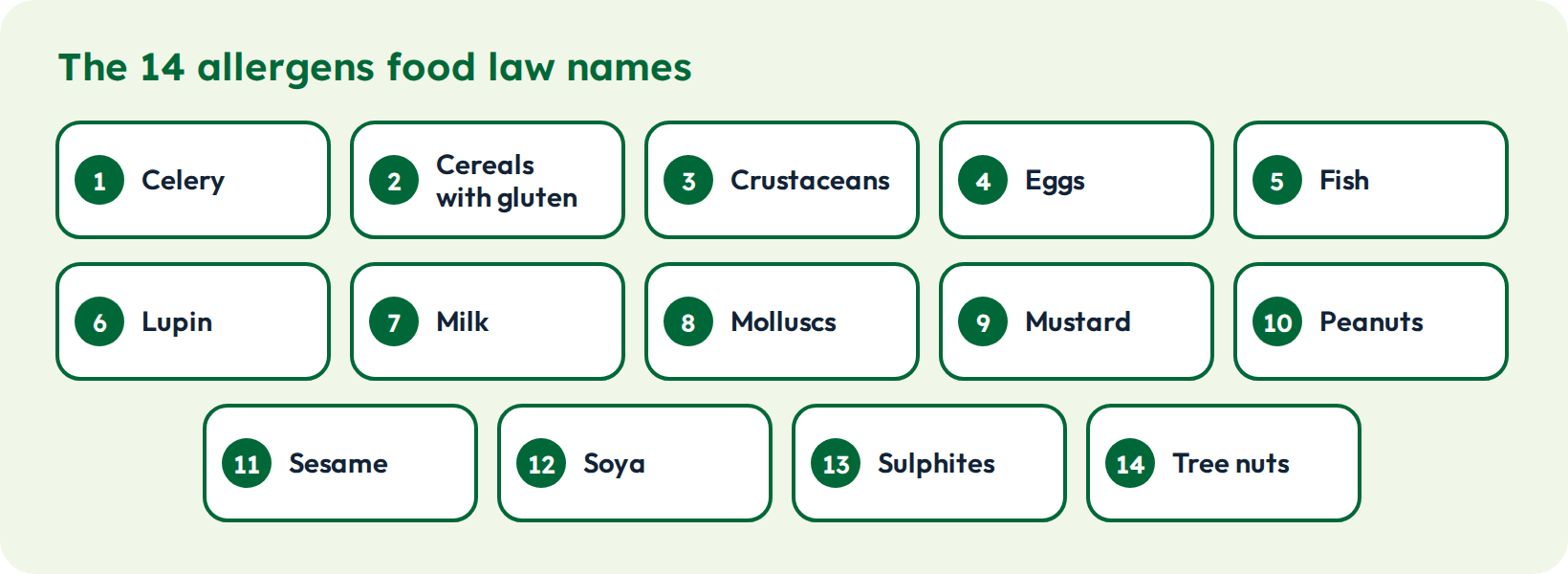
- Celery
- Cereals containing gluten, such as wheat, rye, barley and oats
- Crustaceans, such as prawns, crabs and lobsters
- Eggs
- Fish
- Lupin
- Milk
- Molluscs, such as mussels and oysters
- Mustard
- Peanuts
- Sesame
- Soybeans
- Sulphur dioxide and sulphites, at more than 10 parts per million
- Tree nuts, such as almonds, hazelnuts, walnuts, brazil nuts, cashews, pecans, pistachios and macadamia nuts
There is more background in our article on the 14 major allergens.
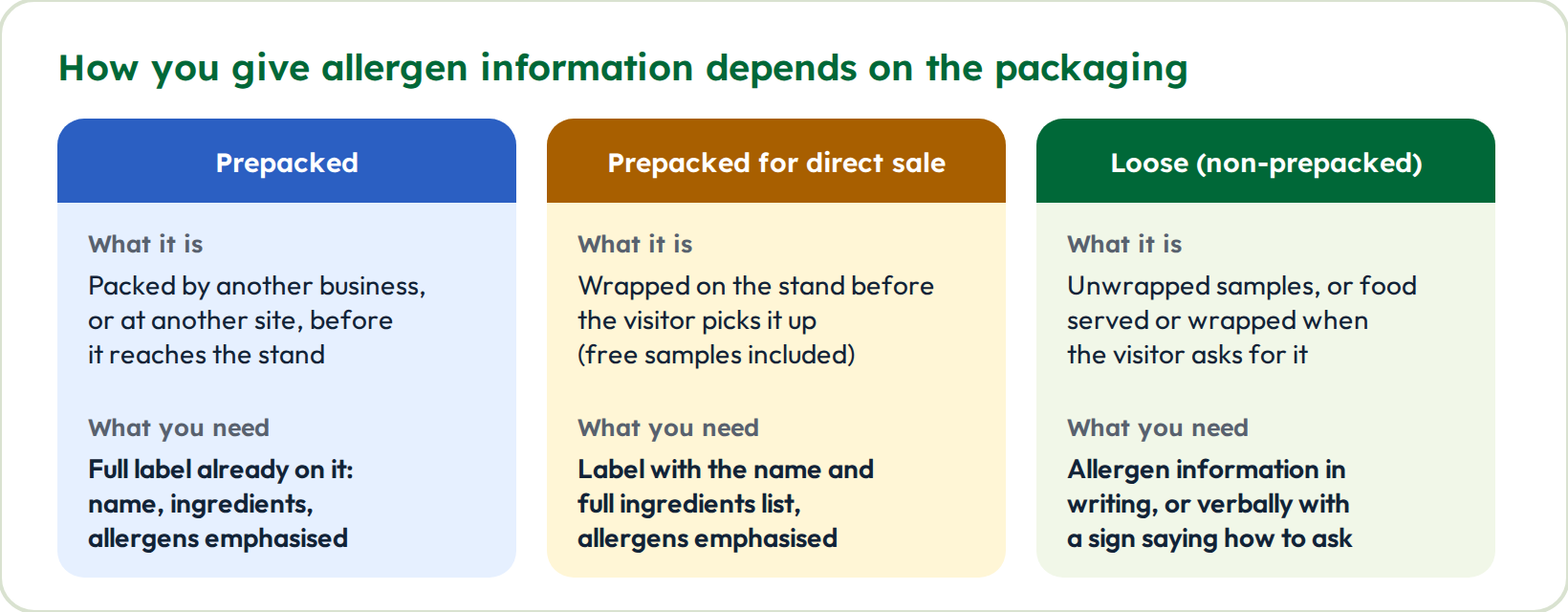
How you give the information depends on the packaging
Loose samples
Most stand samples are loose (non-prepacked): a cube of cheese, a spoon of sauce, a cup of soup. For loose food you can give the allergen information in writing, or verbally as long as a clear written notice tells visitors how to get it. The FSA advises that written information backed by a conversation works best. Treat each item on a sampling table separately, as you would on a buffet: information for the table as a whole is not enough.
Food wrapped on the stand before it is offered (PPDS)
If you pack food on the stand, or at the same site, before visitors choose it, it is prepacked for direct sale (PPDS). Since 1 October 2021 PPDS food needs a label with the name of the food and a full ingredients list, with the 14 allergens emphasised, for example in bold. This is often called Natasha’s Law. The FSA lists free samples of cookies packed on site as an example of PPDS food (FSA introduction to PPDS labelling).
Food you pack at your base and bring to a show is usually prepacked, not PPDS, because it is offered somewhere other than where it was packed. Prepacked food needs full labelling. If you are not sure which applies, the FSA guide for event caterers and its labelling tool are the place to check.
An allergen matrix for the stand
We recommend a simple allergen matrix: every item you serve down the side, the 14 allergens across the top, and a tick where an allergen is present. Organisers often ask for it before the show, and it is the quickest way for temporary staff to answer a question accurately.
- Include everything that goes in a visitor’s mouth: crackers, bread, dips, garnishes, oils and drinks, not just the product you are promoting.
- Base it on current product specifications and labels, not memory. If a recipe or supplier changes, update the matrix.
- Keep it on the stand where staff can find it in seconds, and keep ingredients in labelled containers.
Preventing cross-contamination on the stand
- Use separate, labelled utensils and boards for foods with and without an allergen, and clean them between uses.
- Wash hands between preparing different foods and before serving someone with an allergy.
- Store allergen ingredients in closed, labelled containers, away from other foods.
- Keep samples apart on the display so one does not fall into another.
- Only make free-from, gluten-free or vegan claims if you can control cross-contamination. If you cannot, tell the visitor.
If a visitor has a reaction
Your plan should say what staff do: call for first aid through the venue’s emergency number, keep the packaging and ingredient details, and tell the organiser and venue straight away. Under the eGuide, you investigate any allergic reaction allegation under your HACCP plan, as the food provider, and tell the venue immediately (paragraph 71).