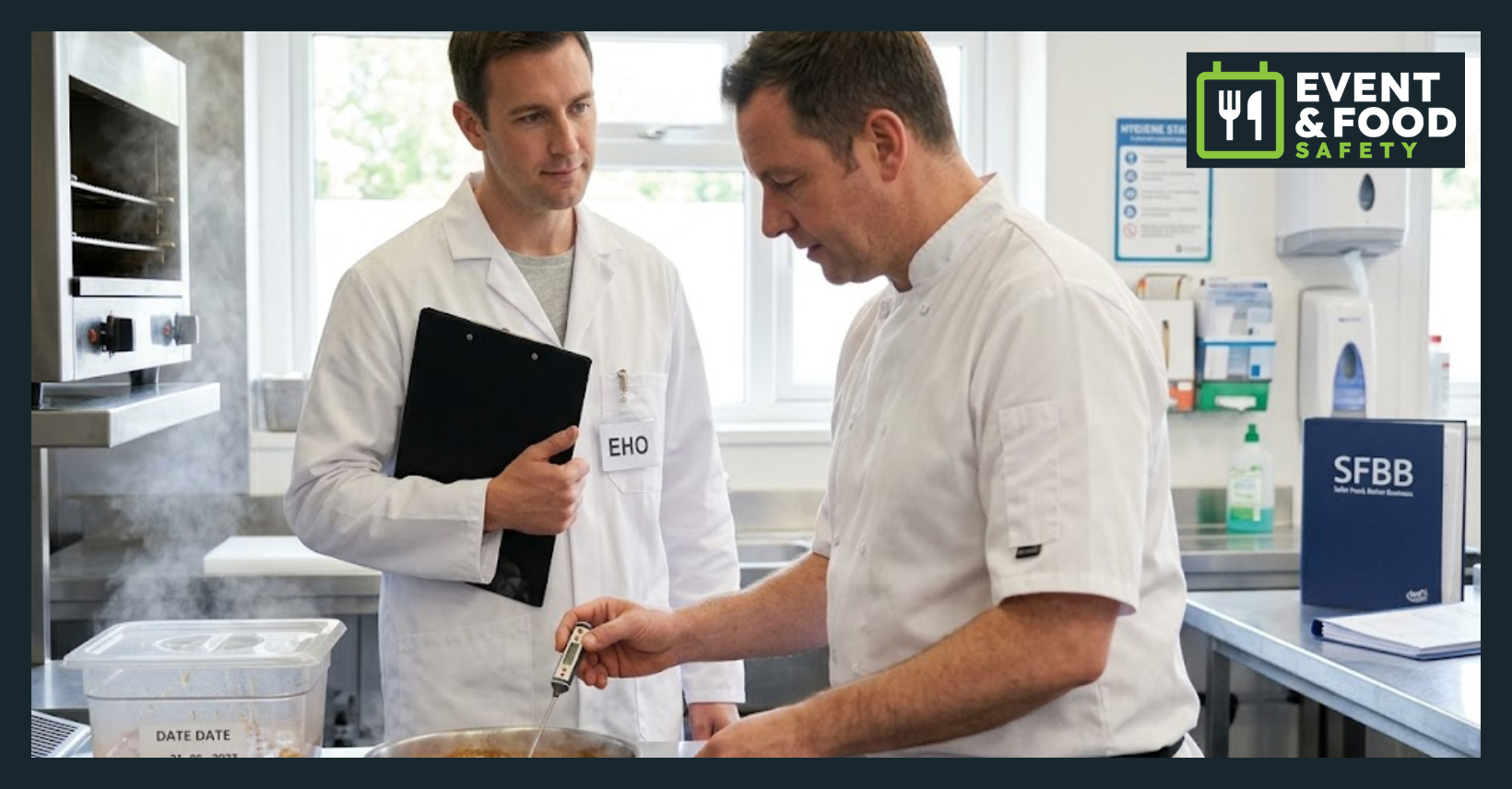
A knock on the door for an EHO visit from an environmental health officer can rattle even a calm team.
I have seen strong operators freeze, not because they were unsafe, but because they were unsure what an inspection would look like, how often it would happen, and what the officer would ask for.
Quick Answer
How often you get an EHO visit depends on risk, not luck.
In England, the Food Law Code of Practice sets minimum routine inspection frequencies by risk category, from at least every six months for the highest-risk premises to at least every 36 months for the lowest-risk Category E sites. Officers can also visit sooner for complaints, sampling, or follow-up work, and visits are usually unannounced. This food safety code is used by the Food Standards Agency and local authorities when inspecting food businesses.
The smartest way to prepare for an EHO inspection is to run your business as if the officer could walk in today.
That means safe food handling, clean and well-kept premises, and strong records that show real control of risk and high food safety standards.
What Decides How Often an EHO Visits?
The short answer is risk.
Your local authority does not usually set an inspection every fixed number of months for every site. Instead, it looks at what your food business does, how risky the food is, how well you manage controls, and your previous record.
Risk Category Sets The Frequency
In England, routine inspection frequency is tied to category scores:
- Category A: at least every six months
- Category B: at least every 12 months
- Category C: at least every 18 months
- Category D: at least every 24 months
- Category E: at least every 36 months
Your record matters as much as your menu.
A business with weak paperwork, poor temperature control, or repeat issues can expect more attention than one that shows steady control and strong food hygiene standards.
Your Type Of Food Business Matters Too
That is why the phrase visit every six months is only true for the highest-risk sites.
A low-risk deli counter, a small café, and a busy event caterer will not all sit on the same timetable. The same rule applies to your next EHO contact and your next EHO inspection. It may be routine, or it may come after a complaint, a food incident, or a poor score.
Some Visits Happen Outside The Routine Cycle
There is one extra point that catches people out.
If you run a food business from home, officers usually arrange a visit rather than turning up without warning.
That is different from many commercial premises, where the officer usually arrives without an appointment.
A visit from an EHO may also happen outside the normal schedule if there is a complaint, a food safety concern, or a reason for a follow-up check. In practice, a visit may happen after customer complaints, wider food hygiene concerns, or a poor previous result, and the officer can visit at any time during business activity.
What Happens During A Food Hygiene Inspection?
A routine food hygiene inspection is not a mystery test.
The officer is checking whether your business follows food safety law and whether food is safe to eat.
What The Environmental Health Officer Looks At
The environmental health officer will look at your premises, how you work, your food safety management system, and the types of food you make and prepare.
In plain English, the purpose of an EHO inspection is to answer three questions:
- Is the building fit for food work?
- Is food is handled safely?
- Can management prove control?
An EHO inspection is as much about management confidence as it is about shine and polish.
A spotless prep area will not rescue weak records, and neat paperwork will not rescue poor handling. The inspection is to ensure the business is meeting legal duties, and the officer will judge the real standards of food safety in place.
Your Checklist Should Reflect Daily Reality
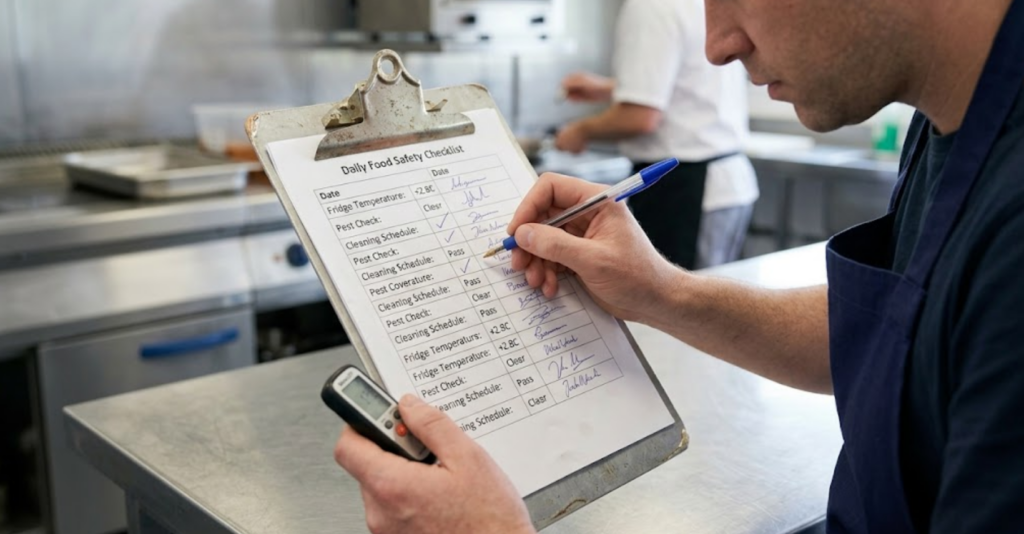
That is why I tell clients not to think in terms of panic cleaning on the day of inspection.
Think in terms of a working inspection checklist that reflects daily reality. A strong food safety checklist covers room condition, cleanliness, staff practices, temperatures, and records.
This kind of checklist works best when the team uses it daily, not just when the EHO inspector is due.
A practical health inspection checklist is also a checklist to help staff stay calm and consistent.
Your Food Hygiene Rating Is Part Of The Outcome
After the visit, your score feeds into your food hygiene rating if your business is covered by the Food Hygiene Rating Scheme.
The scale runs from five, where hygiene standards are very good, down to zero, where urgent improvement is necessary.
That rating shapes trust as well as compliance.
A strong food hygiene rating tells customers your controls work. A weak one tells them you have gaps to close. For many operators, a 5-star food hygiene rating is the clearest public sign of strong control and good daily standards.
How To Prepare For An EHO Inspection
This is where teams either relax or unravel.
When I help clients prepare for an inspection, I structure the work around the three pillars an officer will judge. This also works as a practical EHO inspection checklist and day-to-day checklist for every food business.
Hygienic Food Handling
This pillar covers delivery, storage, food preparation, cooking, cooling, reheating, and service.
Check fridge and freezer temperatures. Separate raw and ready-to-eat food. Label and rotate stock. Make sure staff know allergen controls. Confirm cleaning is built into service, not left until the end.
These food safety practices are the front line against food poisoning.
If you want to prepare for an EHO, start with the way food moves through your site.
Ask yourself where it could become unsafe, then put a control in place. This is the heart of food safety and hygiene, and one of the best ways to prepare for an EHO visit.
Structural Compliance
This pillar is the state of your food premises.
Walls, floors, lighting, ventilation, sinks, storage, and equipment all shape an officer’s view during an environmental health inspection. If the building is hard to clean, the risk rises fast.
A smart checklist catches small faults before they become inspection problems.
Use a daily opening and closing hygiene checklist. Log faults. Fix cracked seals, broken tiles, damaged chopping boards, and poor extraction before they become patterns. An inspection checklist will help your team spot small failures before an officer does. This is also part of wider health and safety and site presentation.
Confidence In Management
This is the pillar people miss, and it is usually the one that decides whether an officer trusts you.
Your food safety management system should show how you identify hazards, control them, record checks, and act when something slips. This is the core of food safety management and one of the clearest signs of a well-run operation.
This is the part that turns a tense visit into a calm one.
When the officer sees a live system, trained staff, and clear due diligence, your understanding of food and your control of risk become easy to prove. This is what the EHO will assess, and it is often what the EHO will want to see first.
Keep your prep folder ready. It should include:
- HACCP or SFBB documents
- temperature logs
- cleaning schedules
- probe calibration checks
- pest control records
- staff sign-off sheets
- evidence of food hygiene training
Training And Equipment Matter Too
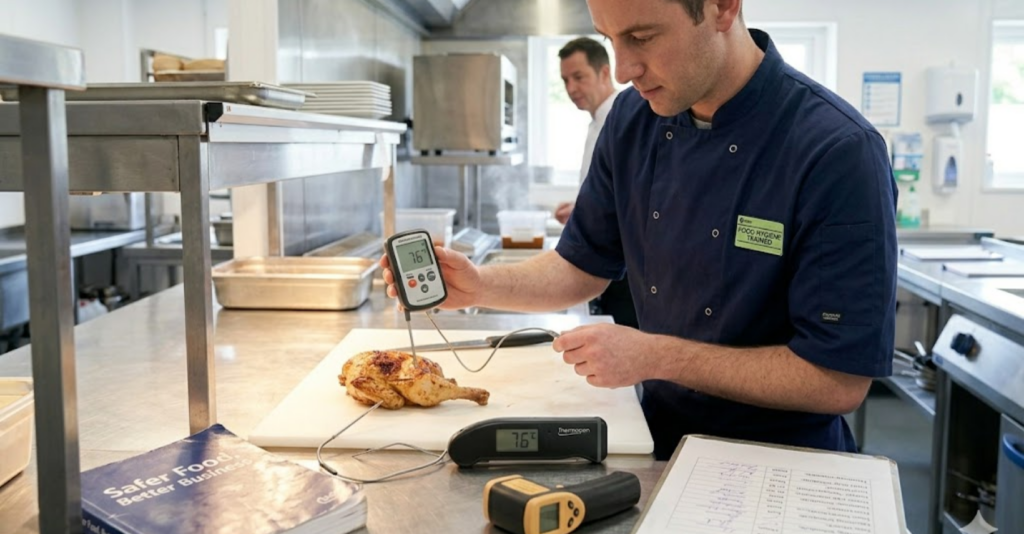
Paperwork alone is not enough.
Your team needs adequate food hygiene training, and your site needs tools that support a high standard of control. We recommend pairing records with practical temperature monitoring and clear supervision.
At Event & Food Safety, we support businesses with Highfield-accredited training, consultancy, and specialist equipment for managing food safety in live service settings.
For practical monitoring, the shop includes tools such as the Digital Fridge Freezer Alarm Thermometer, FoodCheck Thermometer & Probe, RayTemp 3 touch-free food thermometer, and Thermapen One. Those products fit the real checks teams need during storage, service, and verification, including checks made while using the food in busy service periods.
This is also where you prepare for an EHO inspection in a way that feels real, not staged, and where confident teams prepare for EHO inspections as part of normal practice.
What Happens After An EHO Visit?
Once the inspection ends, the officer explains what they found and what happens next.
Some operators walk away relieved. Others leave with work to do.
If Standards Are Good
If standards are good, that is the result you build on.
Your overall food hygiene rating will reflect the standards seen at the time of the visit, not the promises made after it.
The result always reflects what the officer sees on the day, not what you meant to do.
That is why daily discipline matters more than last-minute effort. Consistency is what protects your score and supports strong food standards.
If The Officer Finds Problems
When standards slip, an EHO may take formal action.
Depending on the issue, EHO can issue a hygiene improvement notice, and in severe circumstances an emergency prohibition notice can be used to stop unsafe activity.
This is why food safety legislation, food hygiene regulations, and food safety regulations need to be part of daily practice, not something you read after the fact.
In more serious cases, the EHO can recommend prosecution, because the EHO is responsible for enforcing key legal duties and checking that staff follow food hygiene rules.
Failing An EHO Is About More Than A Score
This is where people start worrying about failing an EHO.
I think that phrase misses the point. The real risk is not embarrassment. The real risk is poor control, unhappy customers, legal pressure, and harm to trust.
If EHO finds poor standards, the answer is not spin. It is correction, proof, and follow-through.
In a serious EHO hygiene inspection, the officer may note repeated failings that show weak systems rather than one-off mistakes.
A Practical Food Hygiene Inspection Checklist You Can Use Today
Here is a simple food hygiene inspection checklist you can work through before the officer arrives.
Food Handling Checks
Ask these questions first:
- Are chilled, frozen, hot-held, and cooked foods in the right range?
- Can you show how food is safe at each stage?
- Are raw and ready-to-eat foods stored apart?
- Can you ensure that your food stays protected during storage and service?
This section of your checklist should focus on how food is being handled in real time.
This is also where you ensure that your food safety controls work in practice, not just on paper.
Cleaning And Premises Checks
Then move to the building and equipment:
- Are cleaning chemicals controlled and labelled?
- Are surfaces, sinks, and high-touch points clean?
- Are there maintenance issues that affect hygiene?
- Is the site still compliant with food hygiene laws and standards for food work?
This part of the checklist to ensure clean, safe conditions should be reviewed at opening and closing.
Management And Records Checks
Finish with management controls:
- Are records current, signed, and easy to read?
- Can you show that you comply with food safety duties?
- Would a new team member understand your system in five minutes?
- Can you show good food hygiene, basic food hygiene controls, and a clear understanding of food hygiene?
This is the part many teams neglect.
A good EHO inspection checklist does not just ask whether the kitchen looks clean. It checks whether the business can prove control, and the records the EHO will carry away from the visit will reflect that.
Final Word
If you are running a food business, do not wait until EHO comes through the door.
Build routines that ensure that your food business stays safe, organised, and ready. Keep records that prove food is being handled safely. Train supervisors well. Use tools you trust.
Good inspection results do not come from luck. They come from calm systems, clear standards, and daily proof.
That is how you protect guests, meet food safety legislation, support food hygiene and safety, and maintain a high level of food safety across your operation.
For operators who want outside support, Event & Food Safety offers consultancy, accredited training, and specialist monitoring tools built for the pressure points of the food industry. Our blog also has relevant supporting content, including Why Food Hygiene is Vital to Event Safety Training, which fits this topic well. A strong EHO visit outcome starts with steady systems, clear records, and daily control.