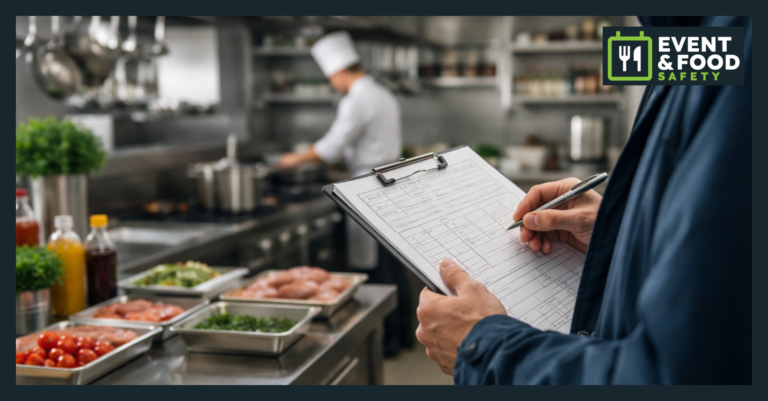
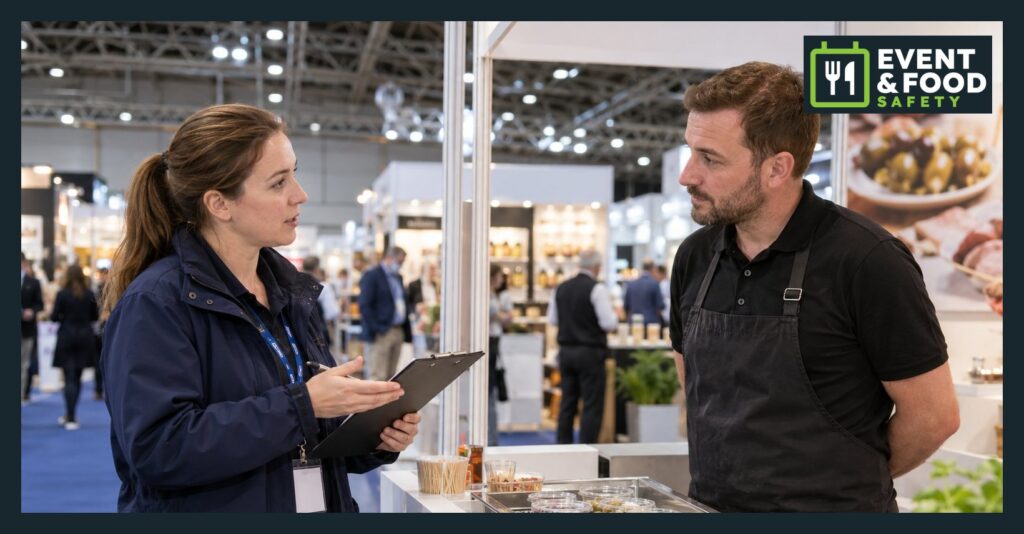
A busy hall, a queue at the counter and a tray of samples going out every few minutes. That is where food safety gets real.
We see exhibitors and traders put huge effort into products, branding and stand design, then get caught out by one basic point when an environmental health officer walks the hall. Not the food itself, but the set-up around it. For a temporary food stall, EHO compliance comes down to one question: can your food business keep food safe on a stand as well as it does in a fixed kitchen?
This food safety guide is written for food stalls and stands at events, from trade shows and exhibitions to food halls, markets and outdoor shows. The law applies to all food businesses, wherever you trade.
Quick Answer
A food stall needs six things for EHO compliance: registration, a stand that protects food and can be cleaned, a wash hand basin with hot running water, safe temperature control, food safety records on the stand, and trained staff.
Miss one of those, and an officer may ask you to stop serving until it is fixed. Organisers of trade shows usually ask for the same things in advance, so getting them right for the organiser also gets you ready for the officer. Get them right and your stand opens on time, with good personal hygiene and the temperature of food under control from the first sample.
Food Business Registration, the Food Standards Agency and the Core Food Safety Laws
Your first compliance step happens before the event starts.
Register Before You Trade
If you sell food, give it away as samples, store it, prepare food or handle it, you are a food business and you need to register with your local authority at least 28 days before you start trading. You register with the council where your business is based (the framework for food registration is the same across England, Wales and Northern Ireland), not every council where you exhibit. Registration is free and cannot be refused.
Temporary Premises Still Need Full Compliance
A temporary stand does not get lighter treatment under UK law. Food hygiene legislation and Food Standards Agency guidance still apply, and the duty to make sure food is safe stays the same. The officer who visits will usually be from the council where the venue is, and they can inspect your stand during build-up or while the show is open.
Environmental Health Checks the Stall Before the Food
The structure around your food matters as much as the products. An EHO will look at the whole stand, not just what you serve. They want to see a set-up that protects food from contamination and customer contact. Understanding how often EHOs visit and what triggers an inspection helps you stay prepared.
Protection From Contamination
Open food should be covered or behind a sneeze screen so visitors cannot contaminate food, and kept out of reach of visitors until it is served. Make sure food is stored off the floor, away from waste and away from the public side of the counter. Outdoors there is weather to deal with, and indoors there is still dust from build-up, packaging, or visitors leaning over the counter.
Surfaces Must Be Cleanable
Counters, tables, containers and storage should be smooth, washable and in good repair. Bare wood, carpet tiles under food areas and damaged surfaces are hard to keep clean. We recommend a wipeable floor covering in any food preparation area.
Personal Hygiene, Food Hygiene and Safety and the Wash Hand Basin
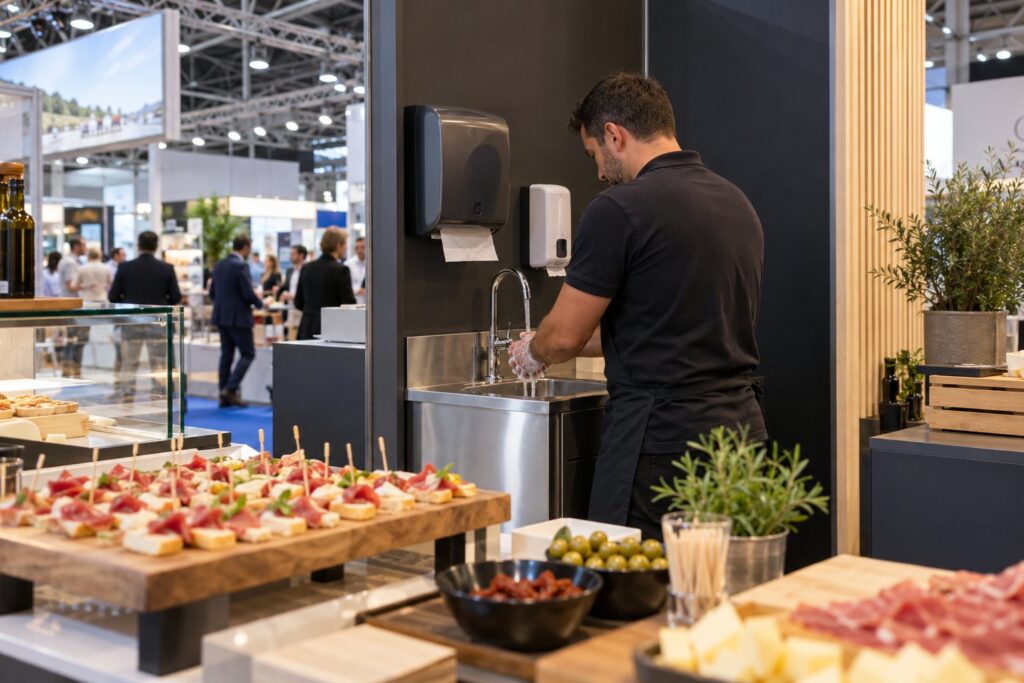
Hand washing is one of the most common reasons a stand is picked up during an inspection. A bowl of water or a bottle of hand gel is not enough.
Hot Running Water, Soap and Paper Towels
Your hand washing point should provide hot running water, liquid soap and paper towels. That is the standard EHOs expect, because food handlers must be able to wash properly throughout service. Many venues can supply a plumbed or self-contained wash hand basin, as mobile food businesses use, for a stand, but you usually have to order it in advance. Our guide to hand washing on stands explains the options.
Keep Hand Washing Separate
The wash hand basin should be used only for hands, not for washing utensils, equipment or food. If you need to wash equipment on the stand, plan a separate sink or take equipment back to a wash-up area.
Personal Hygiene for Food Handlers
Everyone on the stand needs to wash hands before they handle food, after touching raw food, after cleaning, after handling waste and after taking payment or using a phone. Clean clothing, hair tied back and no working with food while unwell all protect safe food and cut the risk of food poisoning. Good food hygiene on a stand looks the same as in a kitchen.
Food Storage and Temperature Control on a Stand
Cold chain control is where well-run stands stand out. High-risk food must stay under control even when the nearest proper kitchen is at the other end of the hall.
Keep Chilled Food Cold
Chilled food must stay at 8°C or below by law in England, Wales and Northern Ireland, and we recommend 5°C or below in fridges. That means reliable display fridges or under-counter fridges on the stand, chilled transport, and a plan for restocking during the day. A digital fridge thermometer in each fridge lets you check at a glance.
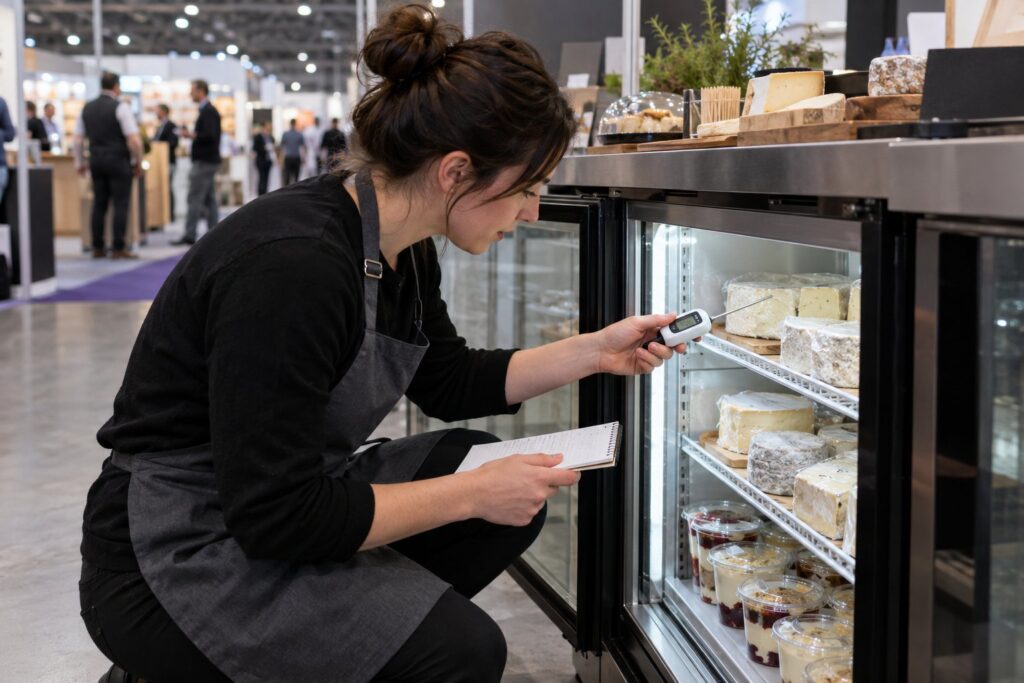
How to Hot Hold Food
If you hot hold food, keep it at 63°C or above during service. Cook demonstrations need the same care: check core temperatures before food is offered to the audience.
Use a Probe Thermometer and Record Checks
Do not guess. Use a probe thermometer to check the temperature throughout the food, not just the outside, and record those checks during service. A calibrated probe such as the Thermapen ONE or ThermaLite Food Probe is one of the most useful tools you can bring to a show, with probe wipes between checks. See our full range of food safety thermometers.
Our show-day list is simple:
- Keep chilled food cold.
- Keep hot food at 63°C or above.
- Separate raw food from cooked food and ready-to-eat food.
- Record checks during trading.
- Throw food away when you cannot show it has been kept under control. Food should be disposed of, not re-served, if in doubt.
Our guide to temperature control on stands goes into more detail.
Time Limits for Food on Display
If you put samples or food out on the counter, you need to know how long they can stay there. The rules in England allow chilled food to be displayed above 8°C for a single period of up to four hours, and hot food to be kept below 63°C for a single period of up to two hours. After that it should be thrown away or, for chilled food, put back in the fridge and not taken out again. We recommend putting out small batches more often so nothing gets close to the limit.
Your Food Safety Management System and Records on the Stand
Paperwork left at the office does not protect your business. A food safety management system shows how your food business controls risk in real working conditions.
Bring Your Food Safety Plan
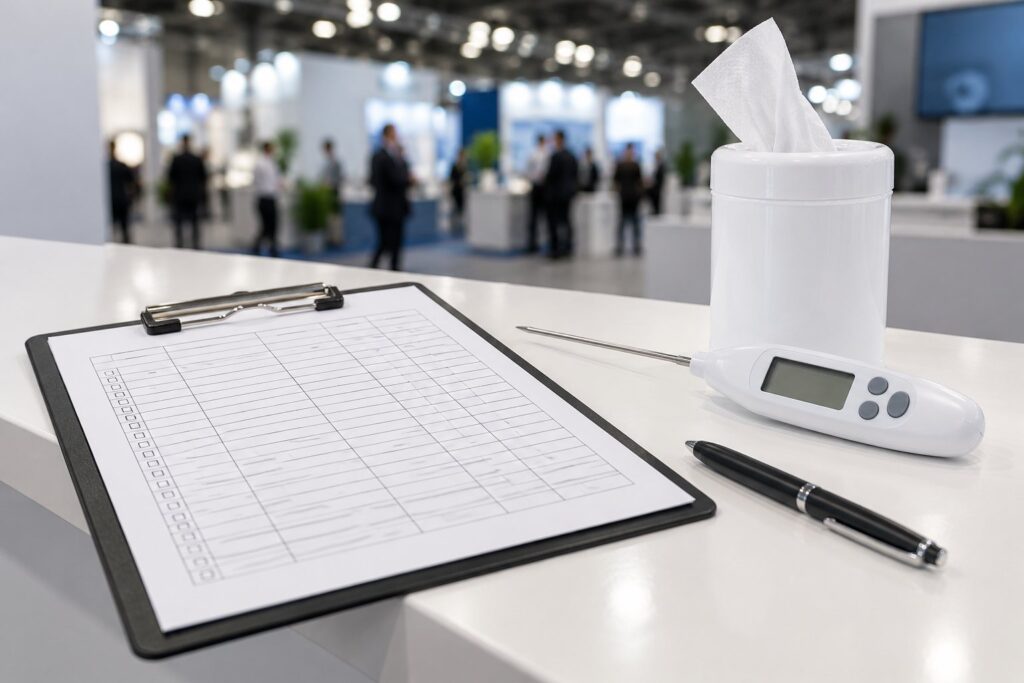
Your food safety plan should be on the stand while you are trading. It may be based on HACCP or the FSA’s Safer Food, Better Business pack. The point is the same: the officer needs to see how you manage food safety in practice. Our food safety plan for exhibition stands shows a cut-down version for show days. If you cannot show it on the day, an officer may assume it is not happening.
Bring the Records That Matter
Keep opening checks, cleaning logs, temperature records and allergen information on the stand. These show your food safety procedures are working. Organisers usually ask for many of the same documents before the show; our guide to documents organisers ask for lists them.
Keep Staff Training Records Available
Training records should be there too. They show that staff are trained, understand hygiene practices and know what could compromise food safety during service.
Food Hygiene Ratings, Training and the Final Environmental Health Test
A smart set-up still falls down if the team does not know what to do.
Your Rating Under the Food Hygiene Rating Scheme
Your rating belongs to your registered business and is based on inspections of your home premises. An officer at an event can still take action, and their findings can be passed to your home authority. To understand how a food hygiene rating is calculated, it helps to know what officers score.
A Level 2 Training Course Gives Staff a Strong Base
Food handlers need training that matches the work they do. For most stand staff, a Level 2 food hygiene training course is the right starting point. It covers food safety and hygiene in full. Ours is online, takes about 3 hours and gives an instant digital certificate, so staff can complete it before the show. Stand managers responsible for the food safety plan usually take Level 3.
Food Allergens Still Matter
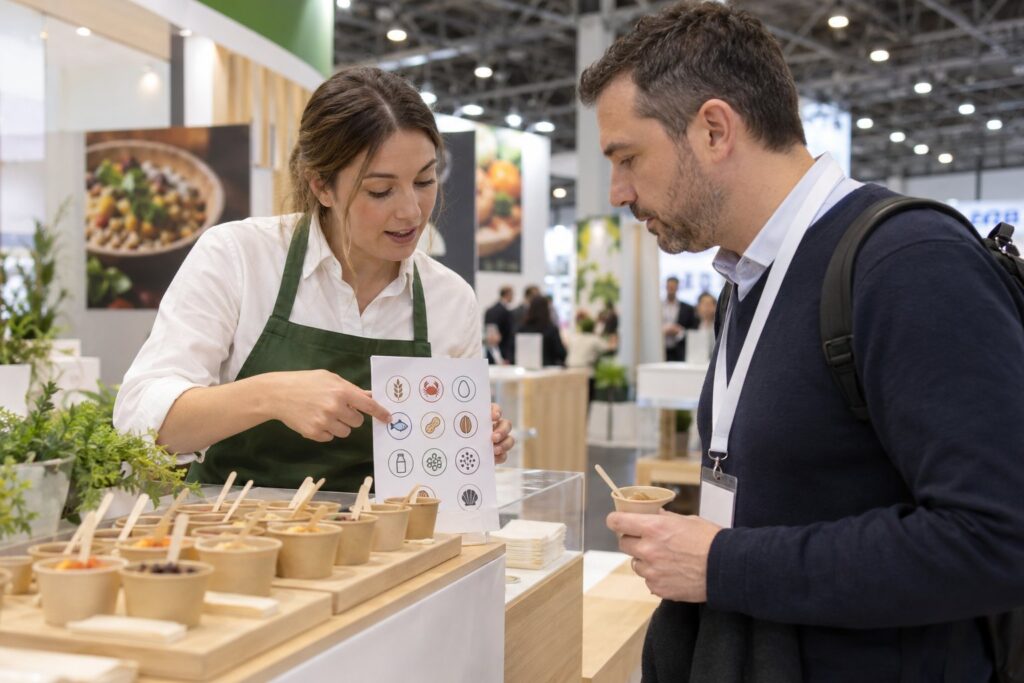
A small stand does not remove allergen duties. Food allergens are one of the first things an officer asks about. If you sell or sample food, you must provide accurate allergen information and manage cross-contact for loose samples and prepacked food. Every person serving should know the 14 major allergens and where the information for each product is kept. Our guide to allergen information on your stand covers what to display.
Health and Safety on the Stand
Food safety is one part of the organiser’s health and safety requirements. You will usually also be asked for a risk assessment covering safety at work on your stand: hot equipment, trailing cables, cooking demonstrations and how food preparation areas are kept apart from visitors. Sending it with your food safety documents saves chasing later.
Who enforces food law at an event?
The council where the venue sits is responsible for enforcing food safety law during the show. Enforcement of food standards, such as labelling, usually sits with trading standards. Food business owners are responsible for meeting both, and they apply to every food business in the UK, whether you operate a food stand for three days or a shop all year.
Do the same rules apply if my stand only hands out samples?
Yes. A food business without a kitchen on site still has to follow the same food safety standards, whether you sell food at a market stall, hand out tasters at a trade show or serve full meals in an exhibition hall. What changes is how much you need to control: fewer steps means fewer checks, but registration, allergen information and temperature control still apply.
What are the 5 basic food safety rules?
Keep it clean, keep raw and ready-to-eat food apart, cook food thoroughly, keep cold food cold and hot food hot, and know what allergens are in everything you serve. Food businesses may be asked to show they follow all five, which on a stand means your plan, your temperature records and your allergen information.
Food Stall EHO FAQs
What does EHO stand for?
EHO stands for environmental health officer. They work for the local council and enforce food law, including at events held in their area.
Is there an EHO food hygiene certificate for a food business?
No. EHOs do not issue certificates. What they look for is evidence that each food handler has been trained to a suitable level, and a Level 2 food hygiene certificate from a training course is the usual way to show it.
Does a stand serving only prepacked food need all of this?
Fewer controls apply, because pre-packed food for sale stays sealed and the risk of food contamination is low. You still need registration, allergen information, temperature control for anything chilled, and clean, protected storage. The type of food decides the rest: a stand serving open samples or cooking needs the full list above, because the food is handled more often and you have to ensure the food is kept at the right temperature all day.
Can environmental health close a food stall at an event?
Yes. If there is an imminent risk to health, an officer can stop all or part of your food activity straight away. In practice most issues are fixed on the spot, such as getting hot water to the basin or moving food into a fridge.
What do I need to open a food stall in the UK?
You need to register as a food business with your local authority, have a food safety plan based on HACCP (or Safer Food, Better Business), trained food handlers, allergen information and a stand set up for safe food handling, with hand washing, chilling and cleanable surfaces. At a trade show the organiser will also ask for insurance and their own exhibitor forms.
Can I display food on ice?
You can, but ice alone often does not keep food at 8°C or below for a whole show day, especially under hall lighting. If you are displaying food on ice, top the ice up often, check the food with a probe (not the ice) and record the readings.
What should a food handler do if they feel ill?
Anyone with symptoms of food poisoning, such as diarrhoea or vomiting, should not handle food and should stay off work until 48 hours after the symptoms have stopped. Make sure your stand team knows to tell you before their shift, not after.
When can an EHO enter a food stand?
At any reasonable hour while you are trading or preparing food. Officers have a legal power of entry under the Food Safety Act 1990, and they do not need to give notice.
What are the key points of the Food Safety Act 1990?
It makes it an offence for a food business operator to sell food that is harmful to health, food that is not what the customer would expect in nature, substance or quality, or food that is labelled or described in a misleading way.
What happened to the Food Hygiene Regulations 2006?
In England they were replaced by the Food Safety and Hygiene (England) Regulations 2013, with similar rules in Wales and Northern Ireland. The food safety and hygiene standards you need to meet are much the same: hygienic premises, safe food handling, temperature control and trained staff.
What happens if I trade without registering?
It is an offence, and the council can take action against you. Registration is free, so there is no reason to skip it. Most organisers also ask for proof of registration before they confirm your stand.
What happens if my business gets a poor food hygiene rating?
The rating stays on public record until your next inspection. You can ask for a re-rating visit once you have made improvements, and organisers sometimes ask about your rating before they accept you as an exhibitor.
Your Stand Safety Requirements in Short
An EHO wants proof that your stand can produce safe food under pressure. The winning set-up is plain: register on time, protect the food, provide proper hand washing, control temperatures, keep records on the stand and train your team.
If you organise events and want help checking exhibitors before the show, see our event safety service. If you are an exhibitor, start with our exhibitor resources.